Friday, August 23, 2013

My Garden 20 August 2013

My garden keeps putting out bucket after bucket of fresh, organic food. Weeding is not much of a problem since the vegetable plants cover most of the ground. 

I planted a second smaller patch of green beans a couple weeks ago and they are doing very good. At the same time, I just picked a gallon of green beans from the original patch. If you picked early and often the plants will continue to produce but at a slower rate. This picture is actually from two weeks ago, before I left for my camping trip. The patch is completely filled with flowering plants now. I should start getting beans from these plants in about two weeks.

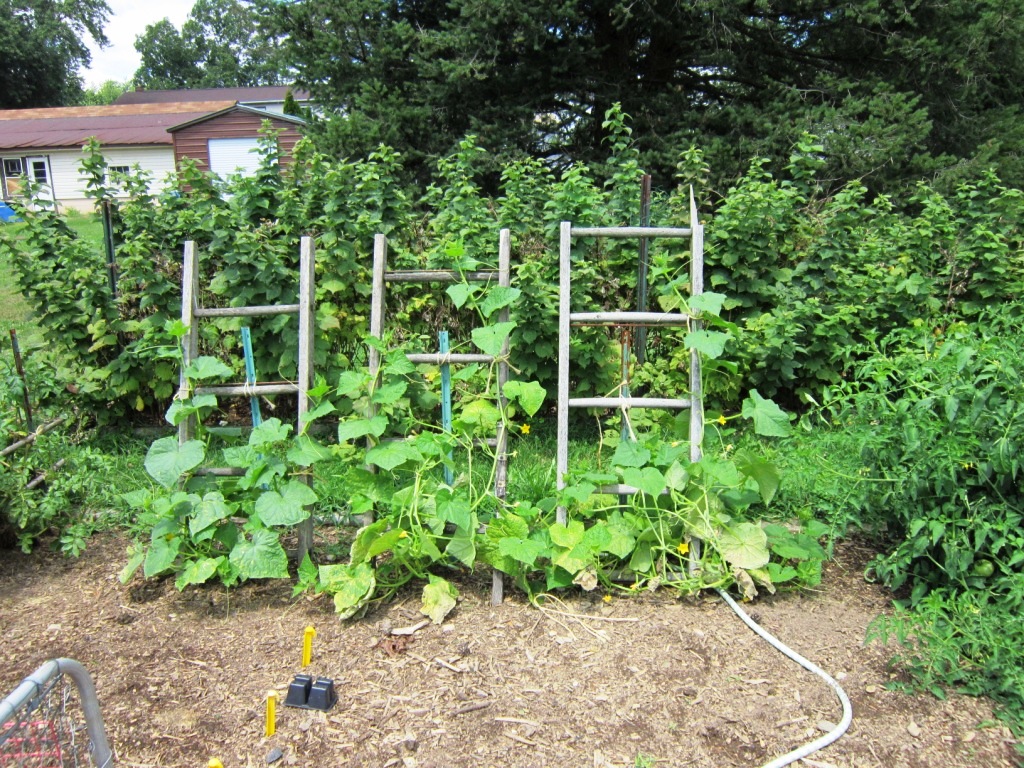


I have already picked seven nice cucumbers from these vines. I trained them up three ladders to save ground space. I have always raised my vine fruits above the ground. They stay cleaner, have less pests, and it is easier to see the fruits.
 
This picture shows the last of my fifty onions still in the ground but they are all picked now. For best storage you should always wait until all the foliage is brown and the bulb is loose in the ground. Then, set them out where it is dry with the roots facing the sun and any breeze you have. It is important to dry the roots quickly to stop growth. That takes about 3-5 days. Once that is done the bulbs need to be further dried on all sides. I usually use some sort of screen or net so that warm dry air can get to all sides of the bulb.  Dry them this way for two weeks and then put them away in a cool dry place and they will last for weeks.

The three blueberry bushes got completely out of control. We picked about four gallons of berries and they just kept coming. I will prune these bushes back hard this winter to make them more manageable and easier to work around. If I had been home more than on the weekends I could have picked at least another four to five gallons of berries. I opened up the netting and let the birds have a feast.


My strawberries produced a bowlful of berries, very tasty too. But the main activity this first year is to send out runners and produce "daughter plants".  In this way, you can triple the number of plants you have for the next year, the main year for producing berries. This is an earlier picture, the bed is now full of new plants. The plants will do this with no help but I find it useful to place the daughter plants where I want them, properly spaced apart, and held in place with small twigs stuck in the ground.

I got peaches for the first time in five years. My father-in-law had planted this tree at least 15 years ago and it did well for him in the early years. But it was over grown and plagued with pests and hasn't produced full-sized fruit in many years. Last winter I pruned it pretty hard but you should never remove more than one third of a tree's branches in any given year. This winter I will cut it back some more and give it a more "open" form. Peaches need to be open on top for sunlight and air flow. So hopefully next year it will do even better.

This has been a good year for my garden.  I have plenty of produce, berries, and cut up peaches in my freezer to feed me later in the year. I should probably harvest my potatoes in about two or three weeks. I am expecting at least a bushel from the ten seed potatoes I planted. The foliage is huge and must have been feeding the tubers (fingers crossed).

Tuesday, July 16, 2013

My Garden 13 July 2013

I missed a couple weeks blogging my garden so here is a catch up.

In the past couple weeks I have picked:
         one and a half gallons of green beans
         one gallon of blueberries
         three quarts of raspberries
         23 radishes
         7 spring onions
         lettuce and spinach
         one Hungarian pepper


The three blueberry bushes I have are out of control this year. Winter and spring weathe must have been near perfect. We have already picked a gallon of berries and there are still twice as many on the bushes. I do not eat blueberries but my family does so we are freezing them in two cup incriments for later baking.


The green beans are fully mature.  Two weeks ago I noticed that something was eating the plants; all the tips were nipped back. Both rabbits and groundhogs love beans and bean plants. So I brought my new .22 rifle up from the gun locker and allowed it to warm up (my basement is always cold). The next morning I quietly crept out to my garden area and there was a young groundhog. I made a standing head shot at 30 meters; no more groundhog.  I'll eat groundhog, as I have mentioned way back in  previous blog post, but I didn't think my wife was ready for me cooking down a groundhog in her crock pot this particular day. So instead, it became worm food in my compost pile.


My tomato plants are doing good and there are many small, green tomatoes forming. I buried them deep and my soil is rich so they should produce a good crop. My dad's tomatos, three miles west of my place, are showing some early signs of disease. Hopefully it is not moving down the valley and I will have to be sure to avoid those plants.


My peppers and onions are also doing great.  The onions are very large and strong smelling so I'm hoping they will be sharp and powerful tasting. I have two bell peppers and two sweet Hungarian peppers.  All four have young fruit on them.  I ate one Hungarian pepper in salads last week and it was very tasty. I have not tried any of the onions yet.
I planted six old, (at least five years old), cucumber seeds two weeks ago. Five seeds germinated but it appears that one was eaten. I was only going to grow three plants anyway so this is fine. I obtained the three ladder sections from a neighbor's burn pile. I always grow my cucumbers up off the ground. This takes up less space and keeps the cucumbers cleaner and away from slugs and other ground critters. The fruit grow straighter and are more visible hanging from the vine.


My new strawberry patch is doing okay but not great. I planted 24 plants, there were supposed to be 25, and several died off. Luckily, strawberries send out runners with "daughter" plants growing from them. I am manually locating the daughter plants to fill in the gaps and to keep them from getting too close and crowded, a common problem. You can usually triple the number of plants you have by doing this correctly. You would have  look real closely to see that I use tiny twigs stuck in the ground and crossed over he runners to hold them in place where I want them. I also expose the soil under the daughter plant so that it can root more easily.

Lastly, I have replanted radishes and spring onions in my cold frame. I raised it up off the ground with a brick at each corner and replaced the plastic lid with a mesh lid. This will increase air flow, keep the temperature lower, and partly shade the plants. They are both cool season crops so I am hoping this will allow them to grow properly in the heat of the summer. We shall see...


As you can see there are very few weeds in my garden. I do pick some weeds each weekend but my tillage techniques and close cropping of plants to shade out the soil prevents most weeds from starting. The grass mulch I put down also helps quite a bit.

Wednesday, June 26, 2013

Restaurant Dining - My Ten Rules

I highly recommend you do not pay others to cook and present your food. The added cost is enough that you could easily prepare two additional meals at home for the same price. But sometimes it is sort of unavoidable for social reasons. So what can you do?

First.  Try to eat out at lunch if at all possible. Lunch menus are typically less expensive than evening meals (supper or dinner depending on where you come from).

Second. Avoid the popular all you can eat buffet places (Old Country Buffet, Golden Corral, etc) on weekends; they all jack up the prices on weekends.

Third. Look for coupons and dining specials. My wife and I used to eat at a very nice steak house in Sierra Vista, AZ called "The Beef Baron" on Thursday nights because they had a "Two for one" special to bring people in on the least popular night of the week. Unfortunately they closed and were replaced by yet another Chinese Buffet.

Fourth. Fill up on the endless salad and breadsticks that some chains offer, eat a tiny bit of the main course, and take the rest of it home for a second meal.

Fifth. Avoid alcoholic drinks, they are always way over-priced.

Sixth. Ask for water. Water is free. We take single serve drink packets, those handy little tubes of powder, and add them to the water. I buy mine at any one of the Dollar Store type shops or Big Lots. One dollar buys me anywhere from 8-12 16.9 ounce drinks. A soda or tea at any restaurant will cost $1.59 at least.

Seventh. Share a desert if you must have one. Restaurant deserts (as delicious as they are) are full of empty, unhealthy calories and are expensive, so cut it in half.

Eighth. Look for smart "add-ons". I sometimes treat myself to Peruvian Chicken at work when I must have a "Working Lunch". They charge $5.99 for a 1/4 chicken with two sides (I always get mashed potatoes and coleslaw). For just one dollar more I can get 1/2 a chicken instead of 1/4. So I eat the thigh and drumstick with the two side items, a very filling meal, and take the chicken breast home for supper. It is hard to buy a large cooked chicken breast for a dollar anywhere. I bring my own drink in a cooler bag and take the chicken breast home in the same cooler bag.

Ninth. As mentioned above in eight, I almost always bring my own drink and desert when I eat on the road. I travel a lot and while I usually take a cold lunch with me I often am on the road for longer than one meal. So I bring drinks that I froze at home, which thaw and are available still cold later in the trip.

Tenth. Breakfast is always the cheapest meal you can buy at a diner. You can get a good breakfast at Ikea for less than two dollars.  I often eat at Ikea if I see one and need to eat. For $5.99 you can get 15 meatballs with gravy, mashed potatoes, and a mixed greens salad. That is hard to beat.

Monday, May 27, 2013

My Garden 26 May 2013

Well I found both good and bad in my garden this weekend.

The good is that all my seed potatoes have sprouted and are growing strong. There are twelve plants growing in this staggered row. I have never grown fingerlings so I don't know what to expect when harvest comes. When I grew russets, this row would give me about 15-20 pounds of potatoes. I usually only recommend growing potatoes, which are generally cheap to buy, if you have plenty of garden space and/or you want to eat a certain, special type of potato. I have the space and I have a knack with potatoes so they are a "go to" vegetable for me. I save my own seed potatoes so after this year I won't have to buy any. I also like to keep in practice growing them since in a worst case scenario they are one of the best vegetables to grow since they store so well. I've said before that I am not a "Prepper" and this site is not specifically for "Dooms-dayers" but as an old Boy Scout, I do like to be prepared.


The bad this weekend? We had a very late-season frost last week. It wasn't a killing frost but it did do some damage. If you look closely at my bean plants many of them are "frost-burned" and the leaves are very damaged. All the seeds sprouted except one and I reseeed that one. Actually it did sprout but something nipped it off at the root. So more than half my beans are damaged. I watered them heavily and will give them a week to see how well they recover. It is still early so I can always reseed them. My plan is to plant a batch of beans about every two to three weeks anyway so I have a constant harvest.

My peas are growing slowly but surely. As they get more growth and more leaves they will grow faster. Again, all but one seed sprouted. Most of them are already attaching tendrils to the cages so they will start to climb. I probably could have planted them earlier but we had such a cold, wet spring I couldn't get the soil tilled and prepared.

The onions are also doing quite well. I weeded both the peas and the onions, which took all of ten minutes. I try to weed early and often so that the weeds don't get deep roots. I still need to mulch thse plants and hope to do that next weekend.


I have enjoyed several bunches of radishes already. These have grown very well. I could start picking lettuce and spinach anytime. I ate a couple spinach leaves while weeding and they are crisp and tasty. I probably will not plant anything else in the cold frame until the fall. I will let what I have growing in there mature and harvest as it does. I will need to prepare a anding seedbed to plant these plants outside the box since the weather is (hopefully) warming up enough at night.


I turned my compost and both working piles are too dry to decompose as fast as I would like. We had a pretty good rain this past week but I think I will have to drag the hose down to my compost bins to wet them down and get them cooking again. You must maintain a good balance of moisture and aeration as well as the right balance of carbon and nitrogen levels in your materials.

Happy Gardening!

Monday, May 20, 2013

Apples - "An apple a day keeps the doctor away."

Everyone knows that old saying but just how healthy are apples?

An ingredient found in apple peels has been found by a team of researchers to help prevent muscle weakening in mice.

Muscle weakening often occurs in humans as a result of illness and aging. But so far, it has not been well understood nor has a medicine existed for it. Ursolic acid, also known as pent acyclic triterpene acid, is present in plants that include apples, basil, bilberries, cranberries, elder flower, peppermint, rosemary, lavender, oregano, thyme, hawthorn, and prunes.

Apple peels contain large quantities of ursolic acid and related compounds. Ursolic acid commonly is used in cosmetics and is capable of inhibiting various types of cancer cells.

Animals given ursolic acid became leaner and had lower blood levels of glucose, cholesterol, and triglycerides. The findings therefore suggest that ursolic acid may be responsible for some of the overall benefits of healthy eating.

Americans eat lots of apples, and the food industry produces a lot of applesauce. However, many people are unaware that most of the health benefits are found in the skin, or apple peel. Apple peels are chock-full of special phytonutrients, like phloridzin and phloretin xylogucoside, that give apples their unique and potent antioxidant and anti inflammatory qualities.

Apple polyphenols also can help prevent spikes in blood sugar through a variety of mechanisms.

Flavonoids such as quercetin found in apples can inhibit enzymes, like alpha-amylase and alpha-glucosidase. Since these enzymes are involved in the breakdown of complex carbohydrates into simple sugars, the blood sugar in our bodies has fewer simple sugars to deal with when these enzymes are inhibited.

The polyphenols in apples have been shown to lessen absorption of glucose from the digestive tract, stimulate the beta cells of the pancreas to secrete insulin, and increase uptake of glucose from the blood via simulation of insulin receptors. All of these mechanisms can make it easier to  regulate blood sugar.
It is hard to grow trully organic apples in the US because there are so many pests. Just be sure to thoroughly clean your apples before eating them. I like to put a small amount of peanut butter on slices for a healthy mid-day snack.

Sunday, May 19, 2013

My Garden 19 May 2013

Just a week since my last post and my garden has grown nicely. There were two sub-freezing nights this past week, one night  in the 20's. I was worried about my young plants but everything I have growing now is cold tolerant. The spinach and lettuce are protecte by the cold frame. Ther wasn't any rain this week so I soaked the garden with the sprinkler.


The green beans have aleady sprouted, probably just 2-3 days ago. They do not yet have true leaves but they should by next weekend. They are vulnerable at this stage and hopefully they will make it through the week. The nights are not supposed to get so cold but birds and rabbits are the new threat. The wire grates should help out.


The peas look good, it looks like one failed to sprout but we'll see next week. I can always pop another seed in the round there. The onions are up and growing fast. I said last post that there were 25 planted but there are actually 50 planted sets.


My potatoes were planted deep so they took quite a while to emerge. Now that the leaves will receive sunlight they will grow much faster. I counted nine plants breaking the surface. Hopefully the whole staggered row will sprout.


Inside my cold frame the first radishes I planted are ready to harvest and the second planting has sprouted. I still only have one lettuce plant but I have four spinach plants growing. I will have to reseed next weekend.  Unfortunately, I am only home on the weekends and can't regulate the temperature in the box or water the plants when they need it. But in spite of that some things are growing very well.


I picked half a dozen radishes to take home. I already ate two of them though and they were tasty and mild. This variety is the "French Breakfast" radish and they are mild. I'll grow some sharper ones later in the season. Tasted great with my lunch!

I turned both my compost piles and they were warm enough to steam. They were a little dry so today's light rain should do the piles good. By the time both bins "cook" down, they will leave a little less than half a bin of good compost each. More than enough for my needs.

What are you waiting for? Start growing some food.

Sunday, May 12, 2013

My Garden 12 May 2013

In just a week, or two, there has been some good progress in my garden. It is still far too cold at night to transplant warm season plants like peppersand tomatoes. But I have onions, potatoes, peas, radishes, spinach, and lettuce growing. I also just planted green beans but they won't sprout for 7 - 10 days since the ground is still cool.

I thought I would use tomato cages for my peas this year. I planted peas around the bottom of the cage and they will climb the cage. This will give them a sturdy trellis to climb and plenty of air circulation and access to sunlight. My intent then is to plant peppers and/or tomatoes in the cage after the peas are harvested. That will take advantage of the nitrogen the peas (as legumes) fixed at the roots and deposited in the soil. WheneverI harvest legumes I always cut the plant off at the ground and leave all the roots in the soil to maximize the nitrogen available.


As you can see the onions came up very well. There should be about 25 plants started here. A couple were pulled out by birds but I pushed them back in the soil and they seem to have re-started. I had wanted to mulch the rows but didn't get around to it this weekend. My mom died last week and we buried her on Wednesday. So I have been tied up with family activities.


Protecting the seeds from birds
Green Bean Planting Bed
I have used this technique for planting seeds for many years and it has always been successful. I prepare the seed bed and then scratch out the rows with a stick or trowel. I set the seeds in the dug row and space them slighty more apart then the seed package instructs because the rows will be half the distance apart than the package calls for. Then, instead of pushing the soil back over the seeds, I fill the row trench with compost. This does several things for me. First, it clearly marks the rows. Second, it gives the plants a soft, loose soil to sprout through. Third, it is dark so it warms up faster by absorbing more sunlight, which is converted to heat. Fourth, it will absorb water faster and hold more moisture for longer beause of the high organic content (100% organic material). Lastly, it will feed the young plants with a slow release natural fertilizer.

I have problems with birds pulling out the sprouted seeds and other night-time critters digging up my seeds and young plants. I salvaged about 60 of these one-foot square wire panels from a dumpster and they work great to protect the seeds. Once th plants are a couple inches tall I can pick them up and store them or use them on other areas.

I like raised beds and eventualy want to convert my whole garden space to a series of raised beds. But for now I till the whole garden space and then use pavers to set off small growing spaces. It does waste some space but it has been a very successful method. I like to use pavers as stepping stones. This keeps my shoes clean and prevents compaction of the soil since I am not walking on the dirt.

 I usually clean up my raspberry patch in early March but had too many other chores to get done. So I finally got to it this week. I cut out the previous year's dead canes to prevent disease and clear space for new growth. Most raspberries fruit on one year old canes and then the cane dies off. If you don't clean the dead canes out the patch gets choked with dead canes and the new canes are crowded out. The dead canes make up about 33% of the plant material in a patch. Once the dead canes are cut out I run them through the chipper/shredder and toss the ground up material on my compost pile. Then I fork in new mulch (mulched yard material picked up with my yard vacuum) to feed and protect the patches' soil.

I did not take any pictures of what is growing in my cold frame this week. I have a good crop of radishes, which I will start picking next weekend, a couple spinach plants, but only one lettuce plant is started. I reseeded onions, radishes, and lettuce.