Friday, January 30, 2015

Rabbit Pie

One of my favorite dishes using rabbit or squirrel is to make a meat pie. It is very simple, very cheap, and very nutritious. Here is how to make it.


Using a crock pot (slow cooker), quarter one large rabbit or two squirrels, place the parts in the crock pot, and cover with water. Add a couple shakes of salt and either celery salt or chopped fresh celery. Cook for 2-3 hours until the meat is tender.

You will need about a quart of what we here in PA Dutch country call, "Filling".  You might call it "Dressing" or "Stuffing". I prefer to use homemade Potato Filling, a specialty in the PA Dutch area, but one of the box stuffings like StoveTop would work. The last rabbit pie I made I used a 75 cent box of no-name bread stuffing from one of those stores that sells recently out of date food items. It was fine.

You will also want some poultry gravy to pour over your serving.

I save leftover vegetables from meals in multiple plastic freezer containers and use them for soups, stews, and dishes like this. But you can use canned or frozen mixed vegetables. I like to use diced onions, carrots, peas, green beans, corn, and potatoes.

Pull all the meat off the bones and dice into small pieces. Throw all the diced meat and vegetables into a frying pan, season to taste, (I usually use a mix of Italian seasoning), and mix well while heating.

Preheat your oven to 400 degrees.

Using your own homemade or frozen pie crust, place one crust in the bottom of a deep bottom pie dish (I always use a glass pie dish). Dump in the now hot mixture of vegetables and meat. Press it down into the pie dish so that it is even across the dish. Add a layer of filling/dressing/stuffing to slightly above the top of the pie dish. Cover this with a second pie crust, any excess can hang below the edge.

Bake your game pie for about 30 minutes at 400 degrees. The crusts should be brown and crispy/flaky. Since the filling mixture was hot when you put them in the pie dish, you are really only cooking the crusts. The internal mixture blends its flavors while the crust bakes.

Scoop or cut out servings onto a plate or bowl, add gravy if you like, and salt/pepper to taste.

Serve with some good crusty bread and you have a great, inexpensive meal. This will serve six people and cost about $3.00 in total.


Tuesday, December 16, 2014

2014 Garden

Well, I had intended to write about my garden this summer but between a nasty surgery and hard recovery and my retirement I never did. So I'll wrap up the year now.

I had a very late start planting because of my surgery. I was unable to walk from February until late May and even then running a tiller or digging was not possible. It was early July before anything was in the ground. Rabbits, deer, and a groundhog plagued my garden. I eventually shot the rabbits and groundhog but there is not much you can do about deer. I surrounded or covered everything with fencing and that solved that problem for the most part.  The rabbits and groundhog went into my compost pile and will be in the garden next year as fertilizer.

This year I managed to plant two tomato plants, six peppers, green beans, onions, sweet potatoes (the first time trying them), zucchini, and radishes. I also had many "volunteer" potatoes grow from potatoes that I failed to find when I dug up last year's crop.  From these plants I harvested the following:

1. Two bushels of tomatoes. I ate some fresh and then made two batches of sauce.
2. Half a dozen peppers. This was disappointing. The plants did not do very good this year.
3. We ate green beans fresh for a couple weeks and I froze 24 servings for this winter.
4. I harvested fifty onions but they were mostly golf ball sized; very strong flavored though.
5. The deer loved the sweet potato vines and ate them back to the ground several times. I finally got them protected with fencing but by then it was late in the summer. Even so I got 30 nice tubers. Then I found out they have to be "cured" before you can store them. I used the half-bathroom in my garage with a small heater to keep the room at 75 degrees for ten days. It was a hassle but seems to have worked. They sweet potatoes are wrapped in paper and stored in my basement.
6. The zucchini were a late afterthought but this worked out very well; no grubs in the vines. I got enough fruit to make eight zucchini breads this winter plus I gave a few away.
7. I always get a good radish crop and this year was no exception.
8. The volunteer potatoes also did pretty good. About ten plants sprouted and I harvested two five gallon buckets.

In addition to that I picked three gallons of raspberries; down from previous years but we had a brutal winter last year. The blue berries, however, did awesome. I picked so many that I was able to sell $80 worth at work and still gave away and froze several gallons of berries. I got quite a few nice peaches from my old, decrepit tree. The previous year's pruning helped a lot and I will cut it back even more this winter.  The big surprise was the half gallon of Elderberries I was able to pick from a couple struggling plants around my yard. These are the first Elderberries I have picked here in thirty plus years. I picked a gallon of wild black raspberries and five gallons of crab apples from my dad's tree.

I have already made six jars of crab apple jelly, which is delicious. I will mix the black raspberry and elderberry juice to make a batch of jelly as well. We had the last jar or pear jelly, that I made last year, for Thanksgiving dinner.

Between the fruits and vegetables from my garden and a deer I just butchered, my freezer is completely full. Not a bad way to start the winter.

Monday, December 15, 2014

Building a Pallet Woodshed

Now that I retired from the Army (a process that kept me from writing this summer) I have much more time to attend to my property. One of the things desperately needed is woodlot maintenance. There are a lot of dead, fallen trees in my three woodlots. These downed trees prevent me from getting into the woods and the newly opened canopy caused a lot of nuisance ground cover plants to flourish. Green-brier, Asian Bayberry thorn bushes, and Honeysuckle bushes are choking my woods. Nothing larger than a rabbit can crawl through parts of my woods. So, I need to get the downed trees cut up and the understory mowed and cleared.  

I installed a wood-burning stove insert in my traditional fireplace a couple years ago. When I was only home a couple days a month, I never had time to get much wood cut so we only burned a fire once in a while for the pleasure of the fire. It was never enough to seriously heat the house. Now I have the time and the need to cut firewood, but I didn't have a place to store the wood out of the weather. I needed a woodshed.

I looked at all sorts of plans and styles, I have a good idea of what I wanted. The problem was, I didn't have the money to build the ideal woodshed. What to do, what to do? The answer was Pallets. Pallets are all the rage right now. There are sites that show just about everything made out of pallets. So, I started looking on Craigslist for pallets in my area. I found a shipping company that had a whole yard full of pallets and they were giving them away for free, which is my favorite price. I towed my utility trailer there and filled it with free pallets and brought them home.

Then it was a matter of what I could build with them. Luckily, I picked up eight double length pallets and they made the perfect three-wall building.  All I needed were screws and roofing.

Below is the nearly finished shed.

I have since completed filling in the open area at the top of the side walls and have closed off the top two feet of the front to reduce wind-blown rain.  The shed is 8'x8'x8' so, in theory, I could store four cords of wood under cover.

I built the floor from two pallets and raised them off the ground with bricks so that the floor would stay dry, would be level, and would allow airflow to help dry the wood.


The pallets are all screwed together at the corners and anywhere else that two pallets join. 


Once the structure was up on three sides, I also reinforced the sides with salvaged fence boards. The structure is surprisingly solid. As you can see, there will be plenty of airflow to dry the wood.


I had to buy the 2x4s used for the roof rafters. Since they should stay dry I didn't buy treated wood and that saved money.  The roofing is pieced together roofing tin that I got for free from the work site of a barn re-roofing project at a farm up the road from me. They were ten-foot-long pieces of various widths. I have a bucket of roofing nails salvaged from another work site's dumpster.


Below shows the completed shed with two and a third stacks of wood and a few large logs that need to be split. We had a heavy, wind-driven snow yet the wood stayed dry, except for the logs at the front edge of the shed. I don't expect to ever store more than four rows of wood, which is two cords.  If I do add more, I will hang a tarp in the front to prevent rain and snow from wetting the wood.


The total price for this project was $46.00.  Of course, I was able to use a lot of salvaged materials but you might be able to as well if you look long and hard enough. I started gathering materials for this project four months before construction began.

With nearly unlimited access to wood from my own property, I have been able to keep the fire burning whenever the outside temperature went below 50 degrees. Above 50 degrees and my house stays at 68 degrees from sunlight, interior lights and electronics, and the heat given off by my family. So far, all my heating bills are down 9-15 percent compared to last year. A very good savings, I think.


UPDATE: This pallet-shed has come to its end. I built a new, permanent shed. Follow this link to see the replacement shed: Feed Yourself During Hard Times: Building a new Wood Shed (eatbettercheaper.blogspot.com)

Sunday, September 7, 2014

Jambalaya

Tonight I made one of the best and cheapest meals in a long time. I bought a box of Zatarain's Jambalaya at "Big Lots" for $1.00. The box says when cooked it makes six cups. I followed the directions, which were easy enough. Bring two and a half cups of water to a boil, add the ingredients from the box, bring that to a boil, add your meat (if desired) and lower the temp to a simmer for 25 minutes. I added a handful of shrimp and some cut up sausage. Ten minutes before it was done I fried up a pan of vegetables from my garden; onions, banana peppers, tomato, and green beans with a cut up chicken breast. When the 25 minutes was up I added the Jambalaya to the frying pan and stirred it all together and continued to cook the mixture for ten minutes.

ZATARAIN'S Jambalaya Mix

Everything together cost less than $6.00 and it made five big servings. It certainly was not a typical Jambalaya but it sure tasted good, was very nutritious, and about as cheap as you can get. Having a decent garden helps but even if you bought the veggies it would still be a good deal.

Dollar stores can be a good source of base materials for good meals. I made a great Indian rice dish in much the same way a couple weeks ago but I have to admit I liked tonight's dish better.

Monday, April 28, 2014

Food Prices set to Rise

The price of food goes up as a result of normal inflation, we all know that. But you might have noticed recently that food prices are going up faster than inflation. What is causing this? Several things.

1. Bananas
Fungus Causing Banana Emergency
A fungal disease, Fusarium oxysporum, is well on its way to wiping out the world’s supply of Cavendish bananas – the world’s most popular banana. With no widespread remedies to the naturally occurring fungus available, the prospects are dire to contain the disease from destroying the fourth-largest agricultural product on Earth. The news is reminiscent of the devastation wrought by the same fungus six decades ago against the Gros Michel banana – previously the world’s bestselling banana. The Cavendish replaced the Gros Michel due to their similar tastes, and because of greater disease resistance. Currently, there are no replacement bananas available to fill in for the Cavendish, thus if the Cavendish goes the way of the Gros Michel, bananas could be nothing more than a sweet memory. Banana prices continue to inch nearer to their record highs from March 2012.

2.  Beef
Beef… It May NOT Be What’s for Dinner Anymore
The western drought continues to affect commodity prices, as ranchers send their herds to slaughter in increasing numbers due to the lack of available water. The number of cattle in the United States currently stands at less than 88 million. That’s the lowest level since 1951 – when the population of the United States was 154 million (about half the size of today). As the record drought continues, beef prices could rise 7% to 8% in 2014, and roughly the same amount in 2015. Ground beef may see especially steep price hikes, upwards 10% to 15% this year alone. All of this means consumers will experience food inflation not seen in decades.

3. Pork
 US pork prices rise 10% after virus kills millions of piglets
A virus never before seen in the US has killed millions of baby pigs in less than a year, and with little known about how it spreads or how to stop it, it's threatening pork production and pushing up prices by 10% or more. Estimates vary, but one economist believes case data indicate more than 6m piglets in 27 states have died since porcine epidemic diarrhea showed up in the US last May. A more conservative estimate from the US Department of Agriculture shows the nation's pig herd has shrunk at least 3% to about 63m pigs since the disease appeared. The US is both a top producer and exporter of pork, but production could decline about 7% this year compared to last – the biggest drop in more than 30 years, according to a recent report from Rabobank, which focuses on the food, beverage and agribusiness industries. Already, prices have shot up: a pound of bacon averaged $5.46 in February, 13% more than a year ago, according to the US Bureau of Labor Statistics. Ham and chops have gone up too, although not as much.

4. Corn
Corn is used for so many products and American farmers grow a lot of it. But with  millions of bushels diverted to produce ethanol, a feel good but misguided attempt to lower petroleum imports, the price has recently hit $5.00 a bushel. That is not the peak price but it certainly raises the price of farm animals that are few corn (which is everything). High priced corn raises the price of poultry, pork, and beef. Since the beginning of the year, corn prices have gone up 22%.

5.
Chicken: Poultry prices increased 4.7 percent last year, the Department of Agriculture says, but 2014 is shaping up as one of the most-profitable years ever for chicken producers, as consumers switch from beef and pork. The government projects that Americans will eat the most chicken in three years. The law of "Supply and Demand" dictates that with more demand for chicken and other poultry the prices will go up. The high price of feed corn will inflate prices as well.

6.
Fruits and Vegetables
The ongoing California drought has caused crop shortages that are only expected to worsen. The combination of disease and an unusually cold winter has damaged citrus crops across the Sun Belt. A month ago, you could buy fresh limes at grocery stores priced three for a dollar. But this week, non-organic limes were selling for 79 cents apiece at Safeway stores, and 98 cents each at Fred Meyer. That sudden price spike is the result of a drought has decimated the lime crop in Mexico, where almost all of the limes that are sold in the U.S. come from. The ongoing drought in California could bump up the price for a head of lettuce by 34 percent, to roughly $2.44. Avocados could go up 28 percent, to $1.60 each.
 
Average increases vs. 1 year ago:

  • Chicken:  5%
  • Grapefruit:  6%
  • Wine 8%
  • Beef:  8%
  • Turkey 9%
  • Bacon: 13%
  • Oranges:  23%

These facts make it all the more important for you to develop alternate means to secure food for you and your family. If you page back through this Blog you can find information on gaining food security through:

1. Hunting
2. Fishing
3. Foraging
4. Gardening

This is the time of year for picking and eating Dandelion. Get out and pick and eat this super food.
Click on the Dandelion link above to see that posting again.

Wednesday, April 23, 2014

First Look - 2014 Garden

This year I will attempt to document my garden a little better than I have been able to in the past. I have a lot of pre-retirement activities and then I will be looking for a job so I cannot promise I will be successful, but I will try.

If you have been following my posts you know that I have a garden that is about 12'x30'.  I have been amending the soil with compost and tons of mulch over the past ten years or so. It is very fertile and loose but soil needs continuous work to maintain. This past fall I laid down about nine inches of mulched green grass and leaves over my garden. It was so bitter cold this winter that very little of it has decomposed so I won't till it in this spring. I think I will leave it in place as a weed barrier mulch. This will be a first for me so I am interested in how it works out. (You can see the mulch in the below pictures.)


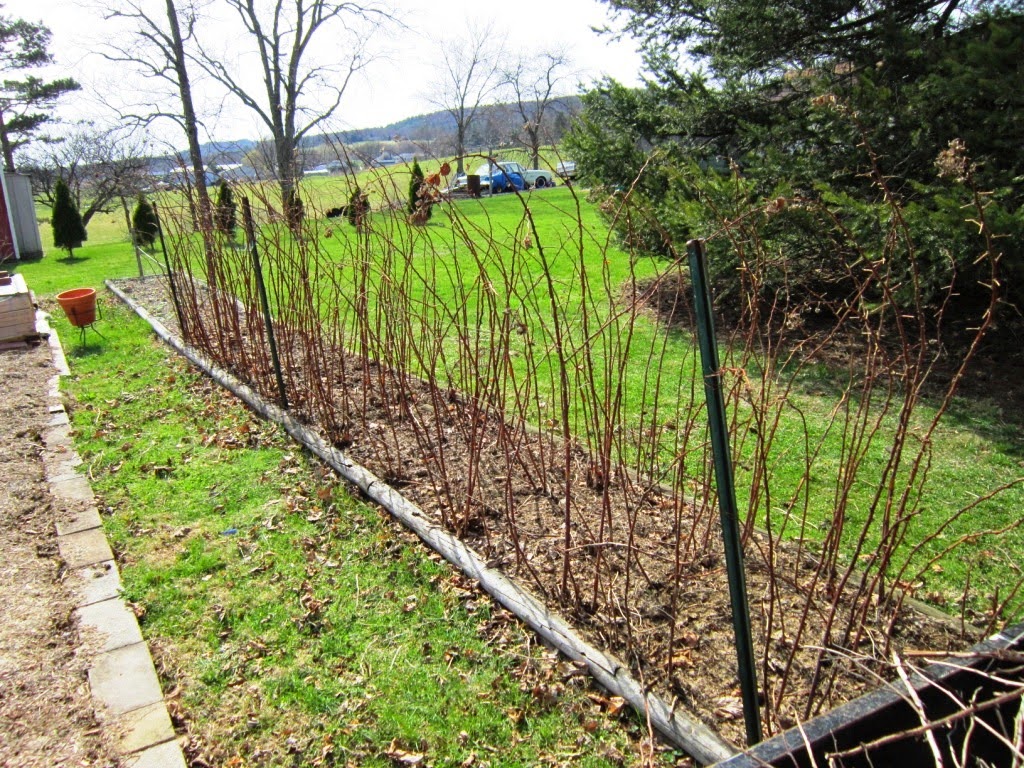
One of the first chores I do, generally in February or early March, is to cut out the old canes in my raspberry patch. This year I was late, just getting to it in mid-April, because I had foot surgery and couldn't walk for two months. Anyway, with the late, cold winter April was not too late. It is not a hard job. I wear gloves and try not to get too scratched as I cut out the old, dead canes. I also tuck any canes back behind the wire so the grass path is kept clear.


If I had to guess I would say that I remove just less than half of the canes in the bed. This opens up the bed so that the live canes are uncrowded and get more sun. I also pull any weeds that are started so I have a clean, tidy patch. I usually run all this through my chipper/shredder but this year I burned the canes.


The next task was to prune and thin my blueberry bushes. Last year the blueberries were out of control. The bushes were too crowded and needed a good thinning. I have always gone by the rule of never trimming more than one third of the mass of a tree or bush so this year I cut out about that much. I wanted to open up the inside of the bushes to get more sun and air and I also need to trim them back to the confines of the raised bed. I have to put bird netting around the bushes when they start to fruit so the branches have to be inside the perimeter of the bed. Next year I will prune them hard again.


Next was the strawberry bed. I completely replanted it last year so this will be the peak year for berries if the extra harsh winter didn't damage the plants too much. Normally I would pull off most of the mulch but we are still getting frosts and I will wait a couple weeks. But I wanted to get the bird netting up to keep rabbits out. There was evidence of rabbits already visiting, some pellets, so this was well needed. You can't see the netting in this photo but it is draped over the white rope. All the higher parts of the plants either froze off or were eaten by the rabbits so all that is there now are mulch-level plants. But they should grow quickly once it warms up.


I had planted a couple spinach seeds in my cold frame in the late fall, curious how they would do. Had it not been so cold this winter I was expecting to be able to pick some now and then but I was not even able to get the lid open because of the huge amount of snow. We got over 70 inches of snow this winter. So imagine my surprise when I opened the lid and saw seven spinach plants happily growing! I will be able to start picking the lower, outer leaves. This was what I did when I lived in The Netherlands; I had spinach and/or lettuce every day for my salads or sandwiches. It gets much hotter in Pennsylvania so it won't last all summer here though.

Next weekend I hope to plant radishes in the cold frame and green peas out in the main garden. The rabbits annihilated my peas last year so I will have to protect them better this year. I have a plan and I'll show you that when I do it.

That's all for now; get out and get your garden started.

Tuesday, March 18, 2014

Food Lines

Think this can't happen here in the U.S.? Don't be so sure. At any given time, due to "Just in Time" supply chains, there is only three days supply of food available in the pipeline. What happens if there is a general disruption to the supply chain for a couple days? Long food lines and rationed food. Think there won't be pushing and shoving?


You need to have at least a couple weeks' supply of the basics to carry you through any shortages. For me, that means dry beans, rice, noodles, and dry soups.  The few things available at the store or in your cupboards can be added to round out your basic meals. This will get you by in comfort while others are struggling.

Check out this LINK for an example of what can happen. Disregard the politics and focus on the food.